
NEP 2020|National Education Policy 2020|NEP 2020 Features|NEP 2020 Objectives|NEP 2020 Higher Education|5+3+3+4 Education System|Academic Bank of Credits|Multiple Entry Exit|NEP 2020 Implementation|NEP 2020 in India|NEP 2020 for Students|NEP 2020 for Teachers|Education Policy India
Introduction to NEP 2020
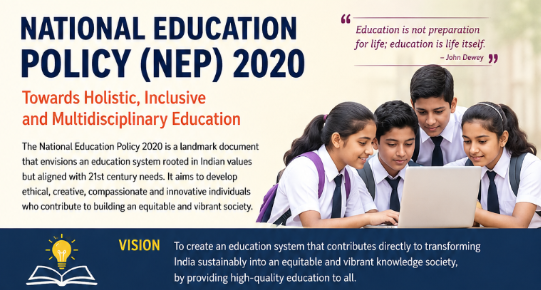
National Education Policy 2020 (NEP 2020) is a comprehensive framework for transforming India’s school and higher education system. The policy was approved by the Union Cabinet on 29 July 2020 and replaced the National Policy on Education, 1986. It is described by the Government as the first education policy of the 21st century.
NEP 2020 envisions an education system that is rooted in Indian ethos while preparing learners for the needs of the 21st century. It emphasizes access, equity, quality, affordability and accountability, with a strong focus on holistic development, critical thinking, creativity, skills, values and multidisciplinary learning.
The policy covers both school education and higher education and proposes significant reforms in curriculum, pedagogy, assessment, teacher education, vocational education, research, technology and institutional governance.
What is NEP 2020?
NEP 2020 stands for National Education Policy 2020. It provides a broad framework for restructuring India’s education system from early childhood education through higher education.
The policy aims to develop learners who possess:
- Knowledge and understanding
- Critical thinking
- Creativity
- Communication skills
- Problem-solving ability
- Scientific temper
- Ethical values
- Social and emotional skills
- Respect for Indian culture and constitutional values
The ultimate vision is to create an equitable and vibrant knowledge society and contribute to India’s development as a global knowledge power.
Five Guiding Pillars of NEP 2020
NEP 2020 is based on five major pillars:
1. Access
Ensuring that every learner has access to quality education.
2. Equity
Providing equal educational opportunities, particularly to disadvantaged and underrepresented groups.
3. Quality
Improving the quality of teaching, learning, assessment and educational institutions.
4. Affordability
Making quality education more accessible and affordable.
5. Accountability
Ensuring transparency, responsibility and effective governance in the education system.
Major Features of NEP 2020
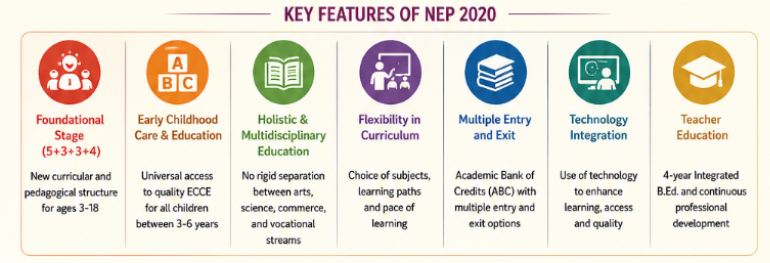
1. New 5+3+3+4 Education Structure
One of the most widely discussed reforms is the replacement of the traditional 10+2 structure with a 5+3+3+4 curricular and pedagogical structure covering ages 3–18.
| Stage | Age Group | Classes/Years |
|---|---|---|
| Foundational Stage | 3–8 years | 3 years Anganwadi/Pre-school + Classes 1–2 |
| Preparatory Stage | 8–11 years | Classes 3–5 |
| Middle Stage | 11–14 years | Classes 6–8 |
| Secondary Stage | 14–18 years | Classes 9–12 |
This structure gives greater importance to early childhood care and education and foundational learning.
2. Early Childhood Care and Education
NEP 2020 places strong emphasis on Early Childhood Care and Education (ECCE) for children aged 3–6 years.
The policy recognizes early childhood as a crucial period for cognitive, social, emotional and physical development.
3. Foundational Literacy and Numeracy
The policy gives high priority to Foundational Literacy and Numeracy (FLN).
The objective is to ensure that children acquire basic reading, writing and numeracy skills at an early stage.
Foundational learning is considered essential because children cannot effectively progress to higher-level learning without basic literacy and numeracy skills.
4. Holistic and Multidisciplinary Education
NEP 2020 seeks to remove rigid boundaries between:
- Arts and Science
- Academic and Vocational Education
- Curricular and Extracurricular Activities
Students are encouraged to explore subjects across disciplines and develop a broader range of knowledge and skills.
For example, a student may be able to combine subjects from humanities, science, technology, arts or vocational education according to institutional offerings and applicable regulations.
5. Emphasis on Indian Languages
NEP 2020 promotes multilingualism and Indian languages.
The policy recommends that, wherever possible, the medium of instruction until at least Grade 5, and preferably beyond, should be the home language, mother tongue, local language or regional language.
This approach aims to improve conceptual understanding while preserving India’s linguistic and cultural diversity.
6. Vocational Education
Vocational education receives greater emphasis under NEP 2020.
The policy proposes introducing vocational exposure from the school level, including opportunities for students to learn practical skills and participate in internships. Vocational education is intended to become an integral part of mainstream education rather than a separate pathway.
7. Changes in Assessment and Examination
NEP 2020 proposes reforms in assessment to move education away from excessive dependence on rote memorization.
Greater emphasis is placed on:
- Competency-based learning
- Conceptual understanding
- Critical thinking
- Problem-solving
- Application of knowledge
- Holistic assessment
The policy also proposes a 360-degree holistic progress card that provides a broader picture of student development.
NEP 2020 and Higher Education
NEP 2020 proposes major reforms in higher education with the aim of making it more multidisciplinary, flexible, research-oriented and student-centred.
The policy envisages larger multidisciplinary institutions, greater institutional autonomy, improved research culture, flexible curricula and better access and inclusion.
Major Higher Education Reforms
1. Multidisciplinary Education
Higher education institutions are encouraged to move toward multidisciplinary and holistic education.
Students should have greater opportunities to study across disciplines rather than being confined to narrow academic streams.
2. Flexible Undergraduate Programmes
NEP 2020 provides for flexible undergraduate education, including three- or four-year degree programmes and multiple exit options with appropriate certification.
The policy gives examples such as:
- Certificate after 1 year
- Advanced Diploma after 2 years
- Bachelor’s Degree after 3 years
- Bachelor’s Degree with Research after 4 years
Implementation depends on applicable regulations and institutional frameworks.
3. Multiple Entry and Exit
One of the major innovations associated with NEP 2020 is the concept of Multiple Entry and Exit.
Students who need to discontinue their studies may receive an appropriate qualification based on the duration of study and applicable academic requirements, and may have opportunities to return to higher education later.
This approach seeks to make higher education more flexible.
4. Academic Bank of Credits
The Academic Bank of Credits (ABC) is designed to digitally store academic credits earned by students from recognized higher education institutions.
It can facilitate the transfer and accumulation of eligible academic credits according to applicable rules.
This is particularly important for flexible and multidisciplinary higher education.
5. Promotion of Research
NEP 2020 places strong emphasis on strengthening India’s research ecosystem.
The policy proposed a National Research Foundation (NRF) to support a strong culture of research and promote quality research across disciplines.
Research is viewed as an essential component of India’s development as a knowledge society.
6. Technology in Education
NEP 2020 recognizes technology as an important tool for improving teaching, learning and educational access.
The policy proposes greater use of:
- Digital learning
- Online education
- Educational technology
- Digital content
- Virtual learning resources
- Technology-enabled assessment
The Ministry of Education has also listed initiatives connected with NEP 2020 such as Academic Bank of Credit and Multiple Entry-Exit, National Digital Education Architecture (NDEAR), National Education Technology Forum (NETF), Virtual Open School and other programmes.
7. Teacher Education and Professional Development
NEP 2020 recognizes teachers as central to educational transformation.
It emphasizes:
- Better teacher preparation
- Continuous professional development
- Improved teaching standards
- Competency-based teacher education
- Greater use of technology in teacher development
The goal is to strengthen the quality and professionalism of the teaching workforce.
8. Inclusive Education
NEP 2020 places emphasis on inclusion and educational opportunities for disadvantaged groups.
The policy discusses measures related to:
- Gender inclusion
- Socio-economically disadvantaged groups
- Children with disabilities
- Regional disparities
- Scholarships and support systems
- Accessible learning resources
The policy also proposes measures such as a Gender Inclusion Fund and Special Education Zones for disadvantaged regions and groups.
Importance of NEP 2020
NEP 2020 is important because it attempts to shift education from a primarily content-focused model toward a more holistic, competency-based and learner-centred system.
For Students
It can provide:
- Greater subject flexibility
- Multidisciplinary learning
- Vocational exposure
- Skill development
- Technology-enabled learning
- Multiple pathways in higher education
For Teachers
It emphasizes professional development, innovative pedagogy and competency-based teaching.
For Researchers
It strengthens the focus on research, multidisciplinary studies and innovation.
For Higher Education Institutions
It encourages institutional autonomy, multidisciplinary education, research and improved governance.
NEP 2020 and 21st-Century Skills
The policy gives importance to skills needed in a changing world, including:
Critical Thinking + Creativity + Communication + Collaboration + Problem Solving + Digital Literacy + Emotional and Social Skills
These skills can help learners adapt to changing employment patterns, technology and social challenges.
NEP 2020 and Sustainable Development
NEP 2020 connects education with broader national and global development goals. Its vision emphasizes responsible citizenship, sustainable development, constitutional values and global well-being.
Education is therefore viewed not simply as a means of employment but as a way to develop responsible, ethical, creative and capable citizens.
Challenges in Implementing NEP 2020
Although NEP 2020 proposes extensive reforms, implementation requires sustained efforts from multiple stakeholders.
Some important challenges include:
- Availability of trained teachers
- Digital infrastructure
- Unequal access to technology
- Language and content development
- Institutional capacity
- Funding requirements
- Coordination between different levels of government
- Curriculum and assessment reforms
- Effective implementation across diverse regions
The Government has identified implementation as a collaborative process involving the Centre, States, Union Territories, higher education institutions, regulatory bodies and other stakeholders.
NEP 2020: Key Points for Students and UGC-NET Aspirants
For competitive examinations and academic study, remember these key points:
- NEP 2020 announced: 29 July 2020
- Replaced: National Policy on Education, 1986
- School structure: 5+3+3+4
- Major pillars: Access, Equity, Quality, Affordability, Accountability
- Important focus: Foundational Literacy and Numeracy
- Higher education: Multidisciplinary and flexible
- Multiple Entry-Exit: Major higher education reform
- Academic Bank of Credits: Digital credit storage and transfer framework
- Research: National Research Foundation proposed
- Technology: Greater integration of digital education
- Vocational Education: Greater integration with mainstream education
- Languages: Strong emphasis on Indian languages and multilingualism
Frequently Asked Questions (FAQs)
What is NEP 2020?
NEP 2020 is India’s National Education Policy announced in 2020 to transform school and higher education through reforms in curriculum, pedagogy, assessment, research, technology and institutional development.
When was NEP 2020 launched?
The Union Cabinet approved the National Education Policy 2020 on 29 July 2020.
What is the 5+3+3+4 education system?
It is the new curricular and pedagogical structure covering ages 3–18 through four stages: Foundational, Preparatory, Middle and Secondary.
What is Academic Bank of Credits?
Academic Bank of Credits is a digital framework for storing and facilitating the transfer and accumulation of eligible academic credits earned by students.
What are the five pillars of NEP 2020?
The five guiding pillars are Access, Equity, Quality, Affordability and Accountability.
What is the importance of NEP 2020 in higher education?
It promotes multidisciplinary education, flexible curricula, multiple entry and exit, research, technology integration, institutional autonomy and greater access and inclusion.
Conclusion
National Education Policy 2020 represents a major framework for transforming India’s education system. It seeks to create education that is holistic, flexible, multidisciplinary, skill-oriented, inclusive and technology-enabled.
From the 5+3+3+4 school structure and foundational literacy to multidisciplinary higher education, Academic Bank of Credits, multiple entry and exit, vocational education and research promotion, NEP 2020 covers a wide range of reforms.
Its long-term success depends on effective implementation, adequate resources, teacher preparation, institutional capacity and cooperation among all stakeholders.
Official Reference: National Education Policy 2020 – Ministry of Education
- World Mental Health Day 2026: October 10 , Theme, History, Importance and Mental Health Awareness
- BTSC Scientific Assistant Recruitment 2026: 6 Vacancies, Eligibility & Apply Online Now
- BTSC Food Safety Officer Recruitment 2026: 105 Vacancies, Eligibility, Apply Online, Exam Pattern
- Bihar Librarian Vacancy 2026: 5,800 Posts, Eligibility, Apply Online
- YUVA AI for ALL: Free Government AI Course in India – Eligibility, Certificate and Registration