
Introduction of INFLIBNET: Objectives, functions and importance in higher education and research. Explore Shodhganga, ShodhChakra, e-ShodhSindhu, N-LIST, VIDWAN, IRINS and SOUL.
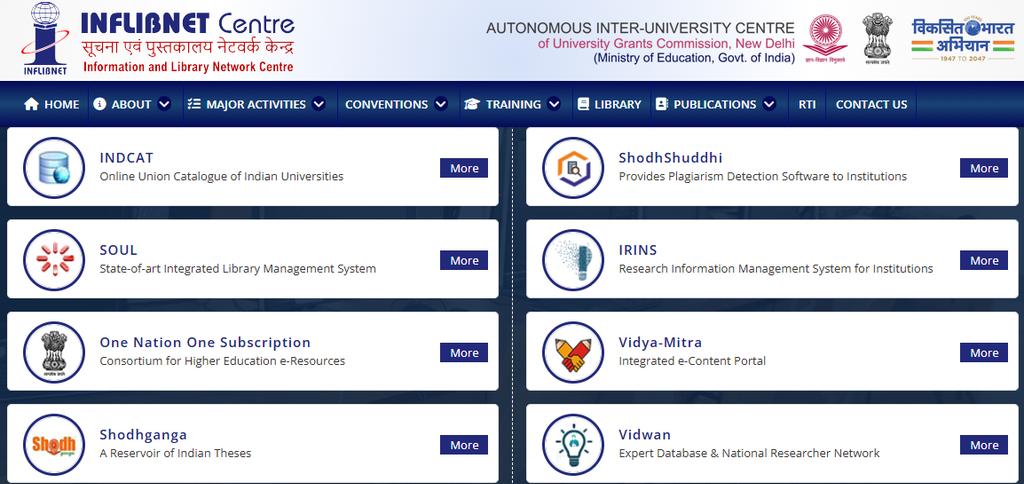
INFLIBNET : Introduction
Introduction of INFLIBNET: INFLIBNET stands for Information and Library Network Centre. It is an Autonomous Inter-University Centre (IUC) of the University Grants Commission (UGC), Government of India, located in Gandhinagar, Gujarat. INFLIBNET was initiated as a project on 27 February 1991 and became an independent Inter-University Centre in 1996.
The main purpose of INFLIBNET is to modernize academic libraries and create an effective network for the sharing and dissemination of scholarly information. It uses information and communication technology to connect university and college libraries and provide students, teachers, researchers and library professionals with better access to academic resources.
In the present digital era, INFLIBNET has become an important part of India’s higher education and research infrastructure. Its major initiatives include Shodhganga, ShodhGangotri, ShodhChakra, e-ShodhSindhu, N-LIST, VIDWAN, IRINS, IndCat, SOUL and ShodhShuddhi.
What is INFLIBNET?
INFLIBNET is a national academic library and information network that promotes library automation, resource sharing, digital information services and scholarly communication.
The basic concept of INFLIBNET can be represented as:
Academic Libraries → Networking → Resource Sharing → Digital Information → Research Support
Through its various programmes and services, INFLIBNET helps academic institutions make better use of information resources and supports the development of a digital research environment.
Objectives of INFLIBNET
The major objectives of INFLIBNET are:
1. Modernization of Academic Libraries
INFLIBNET aims to modernize university and college libraries through computerization, automation, networking and digital technologies.
2. Library Networking
It seeks to establish effective communication and networking among academic libraries and information centres across India.
3. Resource Sharing
One of its important objectives is to facilitate the sharing of books, journals, theses, databases and other scholarly resources among educational institutions.
4. Access to Digital Resources
INFLIBNET promotes access to electronic resources such as e-books, e-journals, research databases and digital repositories.
5. Promotion of Research
It supports research activities by making theses, dissertations, scholarly literature and research information more discoverable and accessible.
6. Library Automation
INFLIBNET promotes the automation of library operations and provides technological solutions for effective library management.
7. Development of Digital Repositories
It develops and supports digital repositories for preserving and disseminating academic and research materials.
Functions of INFLIBNET
INFLIBNET performs several important functions in library science, information management and higher education.
1. Academic Library Networking
INFLIBNET connects academic libraries and facilitates the exchange of bibliographic and scholarly information.
2. Information Resource Sharing
It promotes resource sharing among educational institutions, helping users discover and access information resources available through academic libraries.
3. Development of Databases
INFLIBNET develops databases relating to books, journals, theses, researchers and institutional research output.
4. Digital Repository Services
Through Shodhganga, researchers can discover PhD theses and dissertations submitted to Indian universities.
5. Electronic Resource Services
Initiatives such as e-ShodhSindhu and N-LIST support access to scholarly electronic resources for eligible institutions and users.
6. Researcher Information Services
VIDWAN provides information about researchers, academicians and experts, while IRINS supports the presentation and management of research profiles and scholarly output.
7. Library Automation
INFLIBNET developed SOUL (Software for University Libraries) to support automation and management of various library operations.
8. Training and Capacity Building
INFLIBNET conducts training programmes, workshops and professional development activities related to library automation, digital resources, information management and research support.
Major INFLIBNET Portals and Initiatives
1. Shodhganga
Shodhganga is a digital repository of PhD theses and dissertations submitted to Indian universities. It is particularly valuable for researchers conducting literature reviews and studying previous research.
Researchers can use Shodhganga to:
- Find previous theses
- Study existing research
- Conduct literature reviews
- Identify research gaps
- Understand research methodologies
- Explore references and bibliographies
2. ShodhGangotri
ShodhGangotri is associated with research proposals and synopses. It can help researchers understand research themes and proposals in different academic disciplines.
3. ShodhChakra
ShodhChakra is a research-support platform that helps researchers and supervisors organize and manage research activities and scholarly literature.
4. e-ShodhSindhu
e-ShodhSindhu provides access to scholarly electronic resources, including e-journals, e-books and databases, for eligible higher educational institutions.
5. N-LIST
N-LIST (National Library and Information Services Infrastructure for Scholarly Content) provides eligible college users access to scholarly electronic resources, including e-books and e-journals.
6. VIDWAN
VIDWAN is a database of researchers, academicians and subject experts. It provides information about academic expertise, research interests, institutional affiliation and scholarly activities.
7. IRINS
IRINS (Indian Research Information Network System) supports the management and presentation of researcher profiles and institutional research output.
8. IndCat
IndCat is a Union Catalogue that provides bibliographic information about resources available through participating academic libraries.
9. SOUL
SOUL (Software for University Libraries) is library automation software developed by INFLIBNET. It supports computerized management of various library operations.
10. ShodhShuddhi
ShodhShuddhi is associated with plagiarism-detection support for higher educational institutions and research communities.
Importance of INFLIBNET in Higher Education
INFLIBNET has significant importance in India’s higher education system.
For Students
Students can use academic electronic resources for assignments, projects, academic reading and advanced study.
For Teachers
Teachers can access scholarly literature and electronic resources for teaching, academic writing and research.
For Researchers
Researchers can use INFLIBNET services for literature review, research topic selection, previous research, research-gap identification and scholarly information discovery.
For Libraries
Libraries benefit from networking, automation, resource sharing and digital information management.
For Universities
Universities can improve research visibility, information access and scholarly communication through INFLIBNET-supported services.
Importance of INFLIBNET for PhD Scholars
INFLIBNET is particularly important for PhD research because a successful doctoral study requires extensive knowledge of previous research.
1. Research Topic Selection
Before finalizing a PhD topic, researchers can search existing theses and scholarly literature to understand the research already conducted in their area.
2. Literature Review
Shodhganga, e-ShodhSindhu and other scholarly resources can help researchers identify relevant literature and understand major academic debates.
3. Research Gap Identification
By comparing previous studies, researchers can identify unexplored areas, limitations, contradictions and emerging research questions.
4. Understanding Research Methodology
Previous theses can provide examples of research designs, methods, data collection techniques, analysis procedures and approaches to presenting findings.
5. Avoiding Unnecessary Duplication
Searching existing research helps researchers determine whether a proposed study has already been adequately investigated and where a new contribution may be possible.
How to Use INFLIBNET for PhD Research
A systematic research strategy can make INFLIBNET more effective.
Step 1: Select Keywords
Prepare several keywords related to the research topic.
For example, for “Buddhist Philosophy and Sustainable Development”, possible keywords include:
- Buddhist Philosophy
- Buddhist Ethics
- Buddhist Economics
- Sustainable Development
- Buddhism and Ecology
- Environmental Ethics
- Compassion
- Buddhist Environmental Philosophy
Step 2: Search Shodhganga
Search the keywords individually and in different combinations.
Step 3: Examine Relevant Theses
Initially focus on:
Title → Abstract → Contents → Introduction → Objectives → Literature Review → Methodology → Findings → Conclusion → References
Step 4: Prepare Research Notes
For every important source, record:
Author + Year + Topic + Objectives + Methodology + Findings + Research Gap
Step 5: Compare Studies
Compare different theses and research papers rather than relying on a single source.
Step 6: Identify the Research Gap
Ask:
- What has already been studied?
- What remains unexplored?
- What limitations exist in previous research?
- What new perspective can be introduced?
Step 7: Develop the Research Problem
The identified research gap can be used to formulate a clear and researchable problem.
INFLIBNET and Research Methodology
INFLIBNET resources are useful for students studying Research Methodology because previous theses demonstrate how research is actually structured.
Researchers can study the relationship between:
Research Problem → Objectives → Research Questions/Hypothesis → Literature Review → Methodology → Data Analysis → Findings → Conclusion
This makes INFLIBNET valuable for PhD scholars, research methodology students, UGC-NET aspirants and Library and Information Science students.
INFLIBNET and Digital Libraries
INFLIBNET has contributed to the development of digital library infrastructure in Indian higher education.
Digital information services provide several advantages:
- Faster information retrieval
- Remote access to resources
- Digital preservation
- Scholarly resource discovery
- Electronic resource sharing
- Improved research accessibility
Thus, INFLIBNET helps academic institutions move from traditional library services toward a more networked digital information environment.
INFLIBNET and Resource Sharing
Resource sharing is one of the central ideas behind academic library networking.
Instead of every institution independently acquiring every resource, networking can facilitate wider discovery and utilization of resources available across institutions.
Library Resources → Network → Information Sharing → Wider Academic Access
This improves the utilization of scholarly information and supports collaborative academic development.
INFLIBNET for UGC-NET and Library Science Students
INFLIBNET is an important topic for students preparing for UGC-NET Library and Information Science and related examinations.
Important terms to remember are:
INFLIBNET → Shodhganga → ShodhGangotri → ShodhChakra → e-ShodhSindhu → N-LIST → VIDWAN → IRINS → IndCat → SOUL
Students should learn both the full forms and major functions of these initiatives.
Quick Revision Notes
| Topic | Key Information |
|---|---|
| Full Form | Information and Library Network Centre |
| Established as a Project | 27 February 1991 |
| Status | Autonomous Inter-University Centre under UGC |
| Headquarters | Gandhinagar, Gujarat |
| Major Areas | Library Networking, Resource Sharing, Digital Resources and Research Support |
| PhD Thesis Repository | Shodhganga |
| Research Proposal Repository | ShodhGangotri |
| Research Management | ShodhChakra |
| e-Resources | e-ShodhSindhu / N-LIST |
| Researchers Database | VIDWAN |
| Research Information System | IRINS |
| Union Catalogue | IndCat |
| Library Automation | SOUL |
Frequently Asked Questions
What is INFLIBNET?
INFLIBNET stands for Information and Library Network Centre. It is an Autonomous Inter-University Centre of UGC that supports academic library networking, resource sharing and access to scholarly information.
What is the full form of INFLIBNET?
The full form of INFLIBNET is Information and Library Network Centre.
When was INFLIBNET started?
INFLIBNET was initiated as a project on 27 February 1991 and subsequently became an independent Inter-University Centre in 1996.
Where is INFLIBNET located?
The INFLIBNET Centre is located in Gandhinagar, Gujarat, India.
What is Shodhganga?
Shodhganga is a digital repository of PhD theses and dissertations submitted to Indian universities.
Why is INFLIBNET important for PhD scholars?
It supports literature review, previous research, research-gap identification, scholarly resource discovery and research management.
Conclusion
INFLIBNET Centre is an important component of India’s higher education, library and research ecosystem. It promotes library networking, resource sharing, digital repositories, electronic resources, library automation and scholarly communication.
Its major initiatives—including Shodhganga, ShodhGangotri, ShodhChakra, e-ShodhSindhu, N-LIST, VIDWAN, IRINS, IndCat and SOUL—serve different academic and research needs.
For PhD scholars, INFLIBNET is especially valuable for research topic selection, literature review, identification of research gaps, understanding research methodology and developing original research.
The effective use of INFLIBNET can be summarized as:
Search → Read → Organize → Compare → Analyse → Identify Research Gap → Develop Research Problem → Create New Knowledge
Official Website: INFLIBNET Centre

- World Mental Health Day 2026: October 10 , Theme, History, Importance and Mental Health Awareness
- BTSC Scientific Assistant Recruitment 2026: 6 Vacancies, Eligibility & Apply Online Now
- BTSC Food Safety Officer Recruitment 2026: 105 Vacancies, Eligibility, Apply Online, Exam Pattern
- Bihar Librarian Vacancy 2026: 5,800 Posts, Eligibility, Apply Online
- YUVA AI for ALL: Free Government AI Course in India – Eligibility, Certificate and Registration